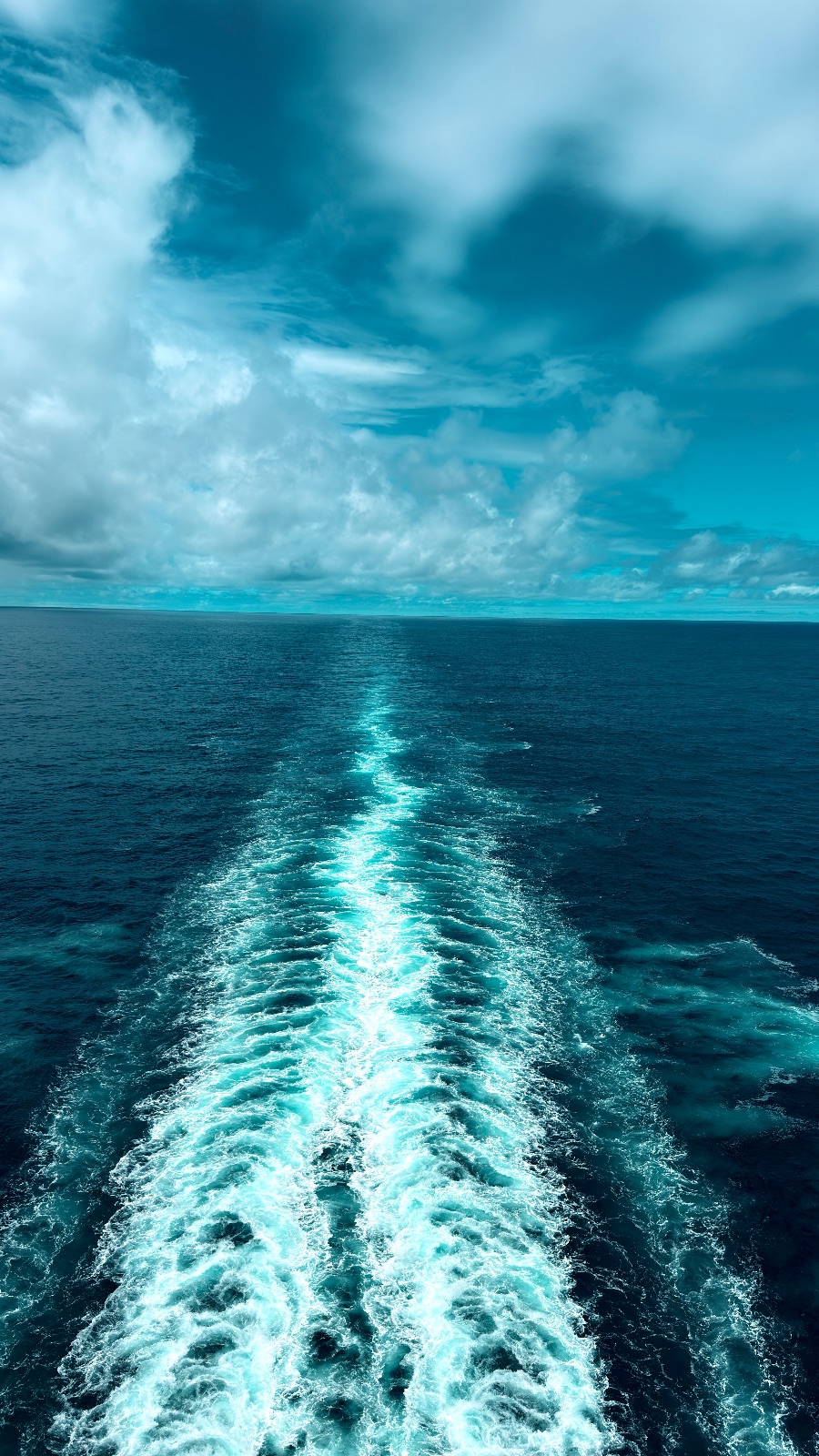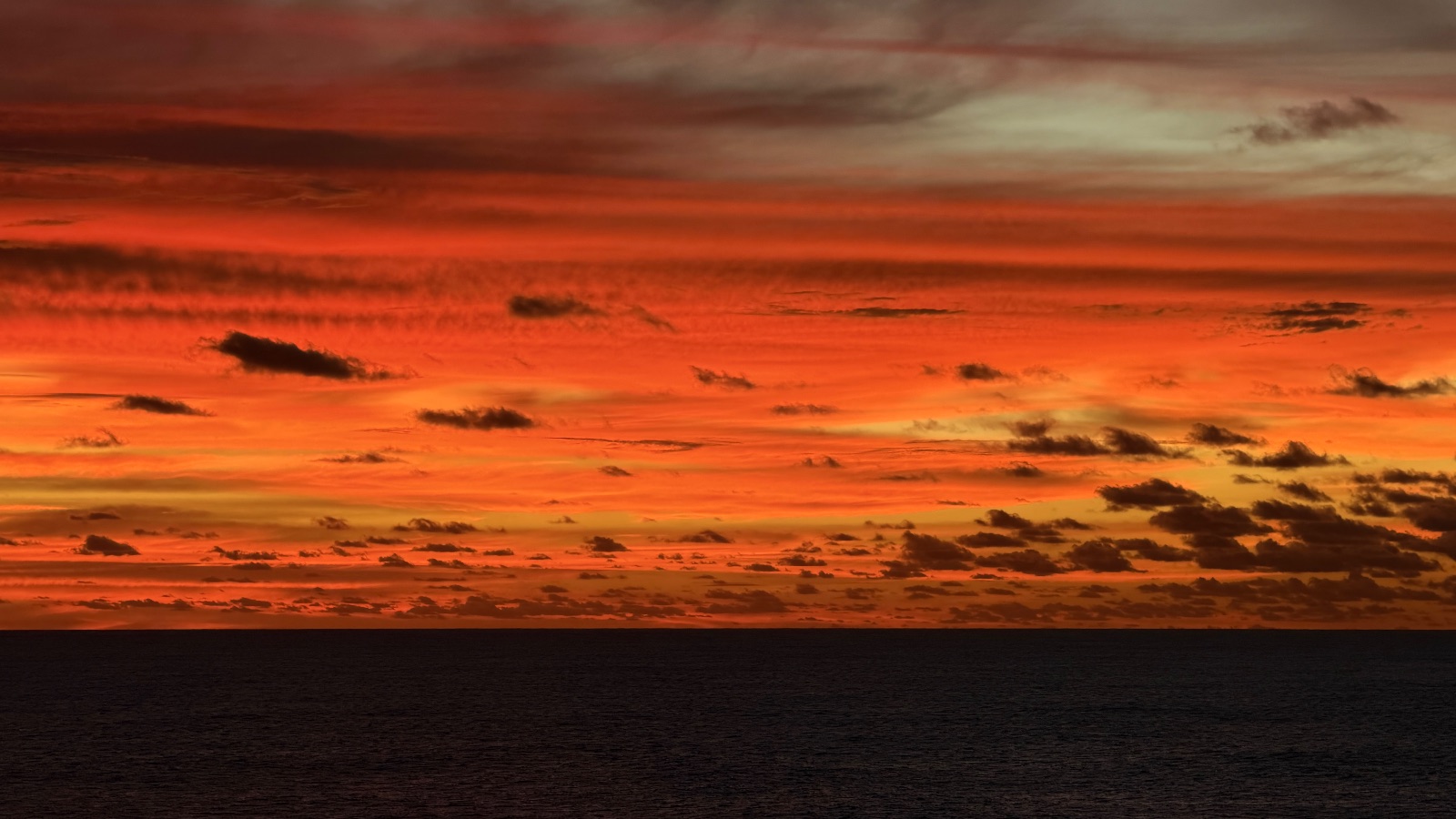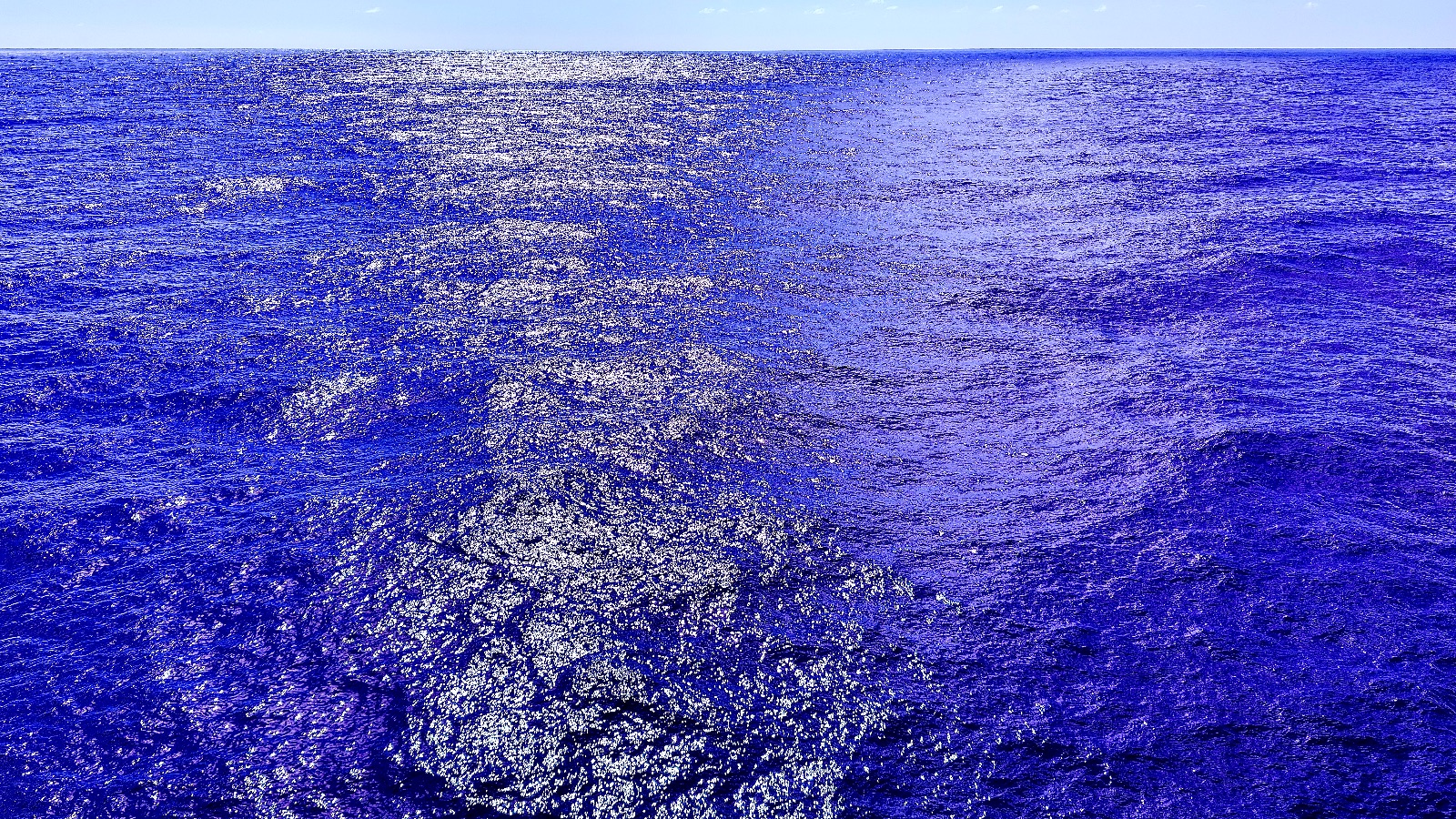
We left Honolulu last night at around 6pm. This morning we wake up with the expanse of the South Pacific enveloping us. We’re heading almost due south, our heading is 172 degrees. In five days we’ll arrive at Moorea in French Polynesia. We are still in the northern hemisphere, but will hit the southern in two days. We really enjoy sea days, so after two really busy days in Honolulu, the next five days are a welcome way for us to relax. Some people think you’d be bored living on a ship with lots of sea days. We don’t. It’s easy to fill a day.
Sea days may not be for everyone. Some people like the evening cruise and a port every day. We did that in Egypt earlier this year. We loved it as well, but missed the easy, relaxed cruising. Next year we’re doing two European cruises on different cruise lines, Viking and Oceania, with few sea days. I’m sure we’ll enjoy those as well, but there’s something totally chilled and relaxing about sliding your way through the vast ocean, finding places to sit, relax, and lose yourself in a book, some crocheting, or just watching the forever-changing seascape in front of you.
Today we rest, read, and enjoy the gentle rolling of the ship, but first we attend a couple of lectures. Celebrity calls them Beyond the Podium. Brent Nixon and Mary-Amanda Fairchild present back to back today.
First Brent, with a fascinating exploration of coral reefs, specifically those around French Polynesia. The reefs here sit among the most pristine in the Pacific, places like Bora Bora and the uninhabited atoll of Tupai, where living coral cover can run anywhere from a quarter to well over 40% depending on the site, a healthier picture than many reefs closer to large populations. What holds the whole system together is a partnership almost too small to see. Corals are animals, but they get most of their energy from microscopic algae called zooxanthellae living inside their own tissue, which photosynthesise and hand over carbohydrates in exchange for a safe home and a front-row seat to sunlight. It’s this relationship that lets corals afford the enormous energy cost of building a limestone skeleton in the first place, and when the water gets too warm and stressed, the coral expels its algae, loses its colour, and the bleaching that follows can be fatal if the partnership doesn’t recover in time.
The symbiosis doesn’t stop there. Giant clams run the same trick, farming zooxanthellae in their own mantle tissue for extra nutrition. And then there’s the clownfish and its anemone, probably the best-known partnership on the reef, where a juvenile clownfish spends its early life rubbing itself against the anemone until the anemone’s stinging cells stop recognising it as food, at which point the two effectively merge households, the fish sheltering among tentacles that would kill most other creatures, chasing off anemone-eating predators, and even dragging food back to share, the anemone’s sting doing the heavy lifting on home security in return. Brent’s usual style again captivates us as he describes this underwater world in vivid detail.
Mary-Amanda follows with a look at the women of Pearl Harbor. I detailed Pearl Harbor a few days ago, but Mary goes much deeper, first describing the tactical aspects of the attack before focusing on three amazing stories of women who individually played key roles.
Cornelia Fort. A 22-year-old civilian flight instructor from Nashville, she was mid-lesson over Oahu on the morning of 7 December 1941 when Japanese bombers swarmed past her tiny trainer on their way to Pearl Harbor. A Zero strafed the runway as she and her student scrambled to land, making her the first American pilot to encounter the attack. She later became the second woman accepted into what became the Women Airforce Service Pilots, and in March 1943, at 24, she died in a mid-air collision during a ferry flight, the first female pilot to die on active duty in American history. She’s played by Jeff Donnell in Tora! Tora! Tora!
Teresa Stauffer Foster, an Army nurse at Tripler Hospital, is one of the women credited with using lipstick as a marker to assist victims of the attack. This was depicted in the 2001 film Pearl Harbor, though the film’s nurse characters are fictionalised rather than drawn from one specific person. Army and Navy nurses that day did mark the foreheads of incoming wounded with lipstick for quick triage, since there was no time for anything more formal, and stockings and whatever else came to hand were pressed into service as tourniquets and bandages.
First Lieutenant Annie Fox. Chief nurse at the 30-bed Hickam Field hospital, she was in the garden that morning when a low-flying Japanese pilot passed overhead and waved. She waved back, and said afterward, “we felt lucky he didn’t want to bomb a hospital.” Minutes later the attack began, and Fox spent it administering anaesthesia, coordinating her six nurses and a flood of civilian volunteers, and keeping the hospital running under fire. She became the first woman in American history awarded the Purple Heart, later converted to a Bronze Star when the criteria changed to require a combat wound.
Mary-Amanda tells their stories passionately and proudly, accompanied by video and photos from that day, a really interesting and informative lecture.
We then head off to lunch, some salad, filet mignon, and Mardi has a bun less burger.
After we relax in the lounge: we try the Retreat deck, but the further south we go, heading to the equator, the warmer and more humid it’s getting. The deck isn’t comfortable, and because we’re sailing at around 20 knots, none of the umbrellas are up, so the deck is just too warm and sticky. We retreat to the lounge, enjoying an iced coffee and a iced chocolate, and enjoy the restful afternoon.
Then it’s time for progressive trivia. A couple we met a few days ago find us to make a team of four, our team name M&M&M&M, their surname starts with an M, so we simply extend our usual name of M&M. Rob and Sue settle in with us as we tick off the first of the five days of trivia. We do well, 14 out of 20, not bad for our first round.
We head back to our room. It’s Evening Chic night, so we rest for a bit before dressing up, Mardi in a gorgeous white Swiss dot wrap dress she made, and me in a black suit with a white floral shirt. We enjoy drinks in Martinis, then go to the theatre to see the captain and senior staff. We slip out of the theatre after the captain’s talk and head to dinner. We both enjoy Jerusalem artichoke soup and sous vide lobster and cauliflower.
Then it’s a night at the casino. Everyone is dressed up, it looks a bit like a scene from Casino Royale. We enjoy Baileys and milk on ice while playing roulette. It takes a while, but eventually the house ends our entertainment as our $2 chips run out. Our favourite numbers come up a few times, 1, 3, 8, 13, 29, but alas not so often as the numbers which aren’t our favourites.
We try the rats, bats, and cats again, but decide to call it quits after $20. Another awesome day on the high seas.